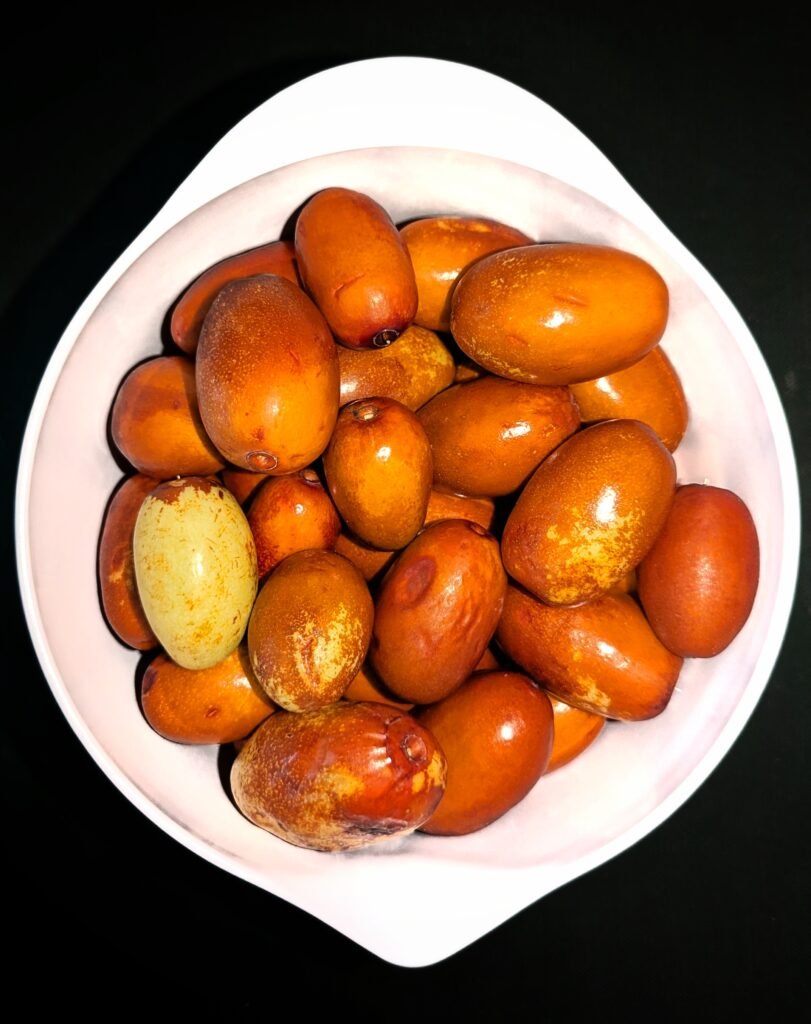
What is Jujube?
Jujube, also called Chinese red date or da zao, is the dried ripe fruit of Ziziphus jujuba. Listed in the 2024 NHC catalog of 106 medicinal-and-edible plants, jujube is one of the “five fruits” of ancient China and a daily tonic for over 3,000 years, present in nearly every Chinese household as a basic health food.
How to Use
Direct eating
3-10 pitted dates per day as a snack. Chewy, sweet, and naturally satisfying. Pit them first; the seed is a choking hazard for small children.
Daily tonic tea
Stew with goji (gou qi hong zao cha) for an everyday blood-nourishing drink, or with ginger (jiang zao cha) for a warming autumn pick-me-up.
Eight-treasure congee
A staple ingredient in eight-treasure porridge (ba bao zhou) along with lotus seed, goji, longan, and other treasures. A single bowl covers a wide range of qi and blood tonics.
Tonic soups
Essential in chicken, pork-rib, black-chicken, and angelica soup. Jujube is also added to many herbal formulas to “harmonize” harsh ingredients and protect the stomach.
Steamed jujube cake
Steamed jujube with rice flour and honey is a traditional festival snack, especially around the Chinese New Year.
How to Choose
Top grades are Xinjiang Ruo Qiang Hui Zao and Shandong Jin Si Xiao Zao: large, plump, dark-red, with thick flesh and a sweet aroma. Store in a sealed container in a cool, dry place; refrigeration prevents sugar crystallization. Vacuum-packed dates keep for one to two years.
Cooked, Not Raw
Eat jujube cooked, not raw in large amounts. Raw jujube is hard to digest and can irritate the stomach lining. Avoid combining with raw fish, raw vegetables, or scallion; classical texts warn against these combinations.


Be the first to reflect
Join the conversation and share your experience with fellow seekers.
Free to join. Reflections earn qi, and your element shows beside your name.